
The Evolution of Sustainable Finance in the Amazon
The Amazon has increasingly become a focus of sustainable finance initiatives seeking to reconcile economic development with forest conservation and improved livelihoods. HPL in its previous blog post: Financing the Bioeconomy in the Amazon, explored how sustainable finance instruments, including GSS bonds and loans, sustainability-linked instruments, Green CRAs and blended finance could help mobilize capital to support the Amazon bioeconomy, forest conservation and sustainable livelihoods.[1] At the time, the discussion centered largely on how existing sustainable finance instruments could be applied to support conservation and sustainable economic activities across the region.
Three years later, the region’s sustainable finance landscape is evolving, with nature’s role in climate change mitigation and sustainable development increasingly reflected in policy commitments and financial market initiatives. The hosting of COP30 in Belém, Brazil, in November 2025 further placed the Amazon at the center of global discussions on climate and forest finance, accompanied by new initiatives aimed at mobilizing public and private capital for forest conservation and sustainable development,[2] like the Tropical Forest Forever Facility (TFFF), designed to provide long-term financing for tropical forest conservation through a blended finance approach.[3] In parallel, a more Amazon-specific sustainable bond architecture has started to emerge. In June 2025, the Inter-American Development Bank (IDB) and the World Bank published the Amazonia Bond Issuance Guidelines (ABIG), designed to enable Amazonia Bonds as a standardized and credible sub-label within the sustainable bond market.[4]
Alongside the development of this architecture, the Amazonia Bond Initiative, led by the IDB under its Amazonia Forever program, is supporting the development of the regional Amazonia Bond market by helping build issuer capacity, identify eligible portfolios, and develop the frameworks needed to bring potential transactions to market.[5] These developments raise a new question for sustainable finance in the region: can an Amazon-specific bond market move from pioneering transactions toward a scalable channel for mobilizing capital?
What Does ABIG Add to the Sustainable Bond Market?
ABIG builds on the ICMA Green, Social and Sustainability Bond Principles, rather than creating a separate market standard. The additional guidance aims to give greater visibility to the Amazon region’s financing needs and sustainable development priorities, while promoting transparency in how bond proceeds are directed toward them. By providing a common reference for eligible investments, environmental and social safeguards, and impact reporting, ABIG seeks to support the mobilization of capital toward activities that contribute to the region’s sustainable development.
Eligible investments span areas including education and employment with a focus on inclusive skills and livelihoods, sustainable urban infrastructure, agroforestry, nature-based solutions and biodiversity restoration and conservation, reflecting an approach that combines environmental objectives with social well-being and economic development.[6] Importantly, the Guidelines place particular emphasis on Indigenous Peoples and Local Communities, alongside Afro-descendants and traditional communities. Their development also included a participatory consultation process involving these groups, as well as potential issuers, governments, civil society and external technical experts.[7] HPL contributed to the technical consultation process that informed the development of ABIG, providing recommendations aimed at strengthening its alignment with international market standards and its relevance for emerging-market issuers.
Another distinguishing feature is the emphasis on Amazon-specific impact measurement. The Guidelines include recommended indicators for eligible activities, intended to help issuers report on environmental and social outcomes relevant to the region. Taken together, these elements give Amazonia Bonds a region-specific framework while maintaining their connection to established sustainable bond market practices.
From Guidelines to Transactions: Is the Market Taking Shape?
Guidelines ultimately matter to the market when they begin to translate into transactions. The first evidence of this transition emerged in November 2025, when the IDB issued its first Amazonia Bond, raising USD 100 million under its USD 1 billion Amazonia Bond Program.[8] The following month, Bancamía, a Colombian microfinance bank, issued a COP 80 billion (approximately USD 20 million) Amazonia Bond in Colombia, fully subscribed by IDB Invest. Structured under ABIG, the transaction was the first Amazonia Bond issued by a private financial institution globally and will channel financing to micro and small enterprises in Colombia’s Amazon region.[9]
In January 2026, the market took another step forward when the IDB issued an AUD 1 billion benchmark Amazonia Bond. The transaction attracted final orders exceeding AUD 3.5 billion, with participation across geographies and investor types, including central banks and official institutions, asset managers, and banks.[10] Figure 1 summarizes this progression from the publication of ABIG to the first Amazonia Bond transactions and the market’s first benchmark issuance.
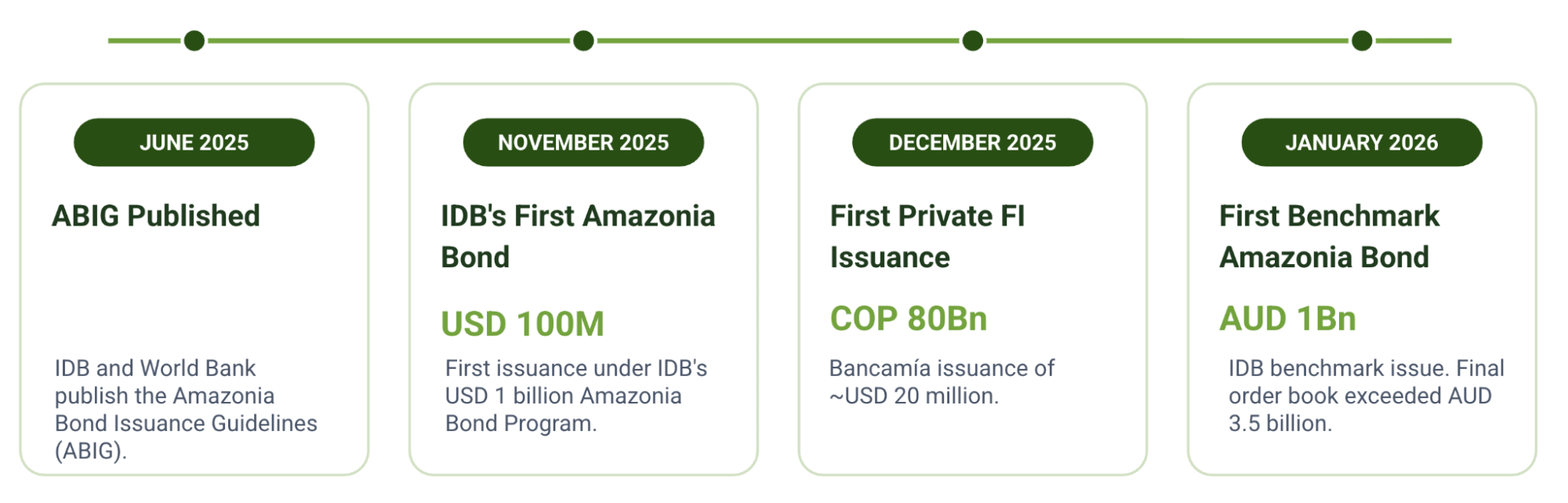
Figure 1. From Guidelines to Transactions: Key Milestones in the Amazonia Bond Market
This progression, from a dedicated issuance framework to transactions by both a multilateral development bank and a private financial institution, provides early evidence that the label can operate in practice. Still, the market remains at an early stage, with a relatively limited and concentrated issuer base. However, these developments suggest that an Amazonia Bond market is beginning to take shape across different segments of the capital market, although a broader and more recurring pipeline of issuances will be needed to demonstrate scale.
What Will Determine Whether Amazonia Bonds Scale?
A first challenge is developing a sufficiently large pipeline of eligible and financeable assets. Potential issuers need not only projects that meet ABIG criteria, but also the ability to identify, aggregate and monitor them at a scale that can support capital-market transactions. Recent World Bank analysis of Amazon conservation finance similarly identifies pipeline development, absorptive capacity and opportunities for coordinated financing as important considerations for improving the deployment of capital across the region.[11] At the sovereign level, ABIG is also beginning to be reflected in national sustainable financing frameworks. In May 2026, Peru updated its Sovereign Sustainable Bond Framework to incorporate the possibility of issuing Amazonia Bonds aligned with ABIG, alongside other thematic sub-labels.[12] Recent developments in Brazil illustrate how parallel financial-policy initiatives could help expand this pipeline. The fourth Eco Invest Brasil auction, launched during COP30 with a focus on bioeconomy, sustainable tourism and enabling infrastructure in the Legal Amazon, mobilized BRL 13.2 billion in 2026, with approximately 70% of the total directed to the region.[13] While separate from the Amazonia Bond market, initiatives of this kind could help expand the broader pipeline of sustainable investments in the region.
Issuer readiness will be equally important. Developing an Amazonia Bond requires institutions to have the governance, internal data systems and technical capacity to identify eligible activities and subsequently monitor the allocation of proceeds and impacts. This is where regional initiatives such as the Green Coalition can play a complementary role. The Coalition brings together 20 public development banks from the Amazon region and has committed to mobilizing between USD 10 billion and USD 20 billion by 2030, while ongoing IDB technical cooperation is specifically focused on strengthening participating banks’ institutional capacities for sustainable finance.[14]
Credibility will also depend on what happens after issuance. Traceability of proceeds, environmental and social safeguards, external review and robust impact reporting will be particularly important in a region where investments can generate interconnected environmental and social effects. These mechanisms will be important not only for demonstrating positive outcomes, but also for identifying and mitigating potential unintended impacts. ABIG provides a common starting point, but consistent implementation of these safeguards will ultimately determine the credibility and integrity of the label over time.
Investor confidence will also be critical as the market expands beyond its initial issuers. Beyond demonstrating impact, Amazonia Bonds will need to offer an investable proposition across different types of issuers and transactions. Clear use-of-proceeds frameworks and comparable impact information can support investor assessment, but scaling the market will also depend on issuers’ ability to combine these characteristics with financially viable underlying investments.
Conclusion: From an Emerging Label to a Scalable Market
Three years ago, HPL explored how existing sustainable finance instruments could help mobilize capital for the Amazon bioeconomy, conservation and sustainable livelihoods. Since then, ABIG has introduced a dedicated reference for Amazonia Bonds, and the first transactions have begun to test that architecture in practice.
The next phase will be less about establishing the label and more about building the conditions for repetition: a robust pipeline of eligible assets, issuers with the capacity to structure and monitor transactions, credible implementation and impact reporting, and sustained investor demand. The development of complementary initiatives, from regional cooperation among development banks to new mechanisms aimed at mobilizing investment into the Legal Amazon, suggests that some of these building blocks are beginning to emerge. Whether they can translate into a diverse and recurring pipeline of Amazonia Bond issuances will ultimately determine whether today’s pioneering transactions become a scalable market.
—
Brenda Aguilar is an Associate at HPL. She graduated with honors from the Law School of the Universidad Nacional Autónoma de México (UNAM), where she also completed the Advanced Postgraduate Course in Financial Law. In addition, she graduated with special honors from the Bachelor’s Degree in Financial Management at the Instituto Tecnológico Autónomo de México (ITAM). At HPL, she has supported the execution of 21 consulting projects related to the structuring of GSS+ bond frameworks for financial institutions, development banks, and corporates across Latin America and the Caribbean (LAC), Eastern Europe, and Africa. She has also contributed to sustainable finance initiatives through research, comparative studies, capacity building, and sustainable finance strategy analysis.
—
[1] HPL (2023). Financing the Bioeconomy in the Amazon. Available here.
[2] COP30 Presidency (2025). COP30 Brasil Amazonia. Available here.
[3] COP30 Presidency (2026). Implementación. Available here.
[4] Inter-American Development Bank & World Bank (2025). Amazonia Bond Issuance Guidelines: Guidance for Labeled Bonds Dedicated to Financing the Economic, Environmental, and Social Development of the Amazonia Region. Available here.
[5] IDB (n.d.) Amazonia Bond Initiative. Available here.
[6] Inter-American Development Bank & World Bank (2025). Amazonia Bond Issuance Guidelines: Guidance for Labeled Bonds Dedicated to Financing the Economic, Environmental, and Social Development of the Amazonia Region. Available here.
[7] Inter-American Development Bank and World Bank (2024). Guidelines on Amazon-Themed Bonds to Help Unlock Finance for the Region. Available here.
[8] IDB (2025). IDB Issues Its First-Ever Amazonia Bond for $100 Million to Finance Sustainable Development. Available here.
[9] IDB Invest (2025). Bancamia: Amazonia Bond to Increase Financing in Colombia’s Amazonia Region. Available here.
[10] IDB (2026). IDB Launches First Benchmark Amazonia Bond. Available here.
[11] World Bank (2026). International Funding for Amazon Conservation and Sustainable Management: Analysis of Reimbursable and Non-Reimbursable Funding from 2013 to 2024. Available here.
[12] Ministerio de Economía y Finanzas del Perú (2026). Marco de Bonos Sostenibles del Perú. Available here.
[13] Brazilian National Treasury (2026). 4º leilão do Eco Invest Brasil destrava R$ 13,2 bi para bioeconomia, turismo sustentável e infraestrutura no país, com foco na Amazônia Legal. Available here.
[14] Green Coalition’s website here.