
The sustainable bond market continues to grow rapidly, with aligned green, social, sustainability and sustainability-linked (GSS+) bonds reaching a record USD 1.05 trillion in 2024 —a year-on-year increase of 31 %— and bringing the cumulative volume to around USD 5.7 trillion, with green bonds alone accounting for approximately USD 672 billion (64 % of total) as of December 2024. [1]
While GSS+ bonds remain a cornerstone of sustainable finance, the emergence of green equity—publicly traded shares in companies that demonstrably contribute to the green economy— offers a complementary path to mobilize capital in support of the transition. Rather than focusing on the use of proceeds, green equity designations assess the environmental alignment of a company’s core operations, including its revenues and investments. Although still nascent, several stock exchanges have introduced green equity designations, signaling growing demand for equities that directly finance climate-aligned business models.[2] By enabling long-term, mission-aligned investments, green equities are gaining momentum as a much-needed complement to green bonds, expanding the financing toolkit and responding to the evolving needs of both issuers and investors.
What Is Green Equity?
Green equity refers to shares in companies that demonstrably contribute to the green economy—defined by the UN Environment Programme as low-carbon, resource-efficient, and socially inclusive.[3] This contribution must be rooted in the company’s core operations, not just in peripheral Environmental, Social and Governance (ESG) practices, and typically includes the generation of green revenues or investments in environmentally positive activities.
To promote consistency and credibility in the emerging green equity space, the World Federation of Exchanges (WFE) introduced the WFE Green Equity Principles[4] in 2023. These were the first global voluntary guidelines designed to support stock exchanges in developing robust frameworks for labeling equities as “green.” The principles aim to enhance transparency in equity markets by distinguishing companies whose core business models contribute substantially to the green economy.[5]
These principles are structured around five foundational pillars: revenues and investments, taxonomy alignment, governance, assessment, and disclosure (see Figure 1). Together, they provide a comprehensive framework to evaluate environmental integrity and minimize greenwashing risk.
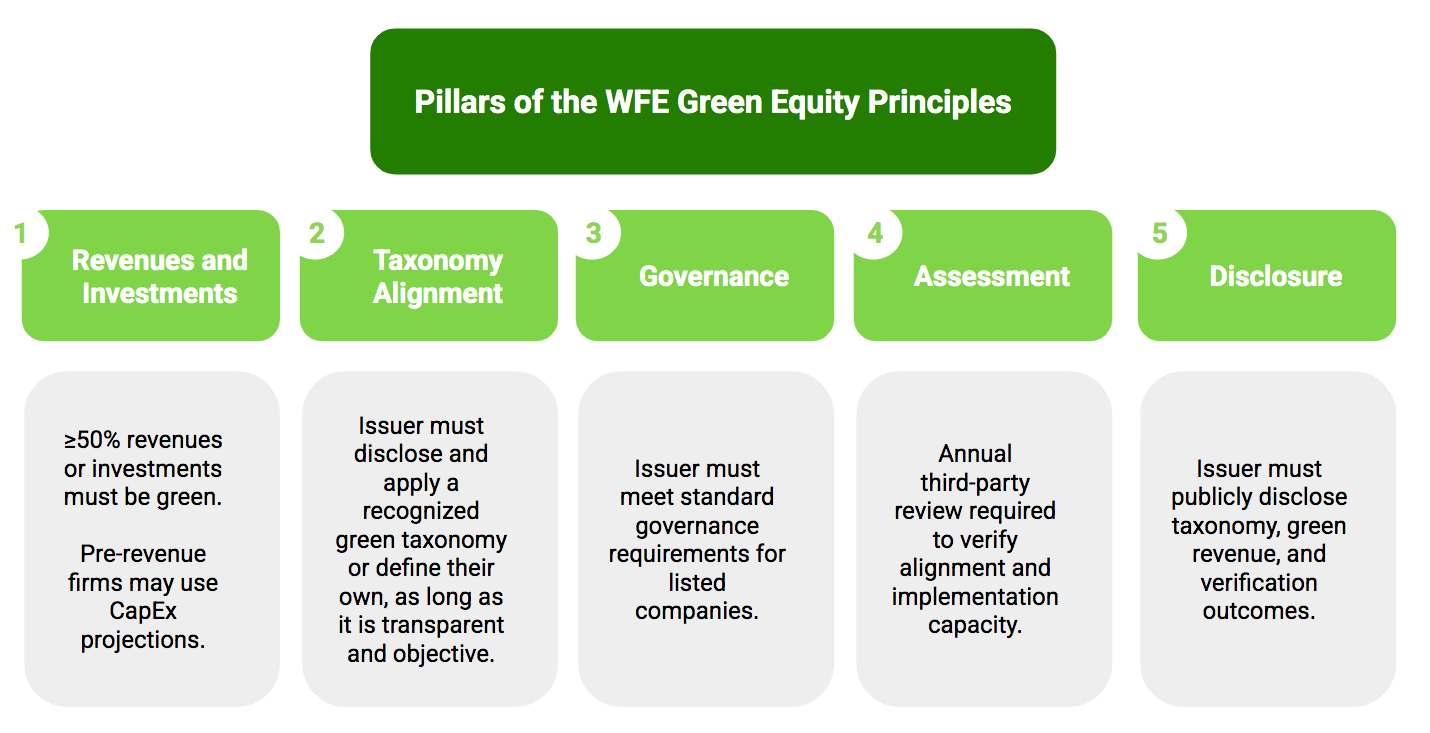
Figure 1. The Five Pillars of the WFE Green Equity Principles
Building on these principles, several stock exchanges have already begun to operationalize green equity through formal labeling schemes. A green equity designation is the official label granted by a stock exchange to shares of companies that meet specific environmental criteria defined in its own framework.[6] Unlike traditional equity, which lacks environmental screening, or thematic ESG investing, which often relies on broad sustainability scores, green equity designations are grounded in formal principles and verifiable metrics. Nasdaq was the first to introduce the Green Equity Designation in 2021, followed by B3 in Brazil with its Ações Verdes initiative in 2024, and SIX Swiss Exchange with the 1.5°C Climate Equity Flag. While each exchange has developed its own criteria to reflect local contexts, all draw on the WFE Principles as a reference to ensure environmental rigor and market integrity.
Companies searching for a green designation can undergo an external review. One example of this is the “Shades of Green” methodology, now operated by S&P Global Ratings. While not mandatory, this approach is applied to companies voluntarily seeking the label and assesses both their economic activities and transition plans using a six-level color scale, ranging from dark green (fully aligned with a low-carbon, climate-resilient future) to red (high transition risk or misalignment).[7]
Together, these mechanisms position green equity as a rigorous and complementary tool in sustainable finance, linking capital markets to measurable environmental outcomes.
Case Studies: Green Equity in Action
As green equity frameworks begin to take shape across global markets, a small but growing number of companies have already navigated the designation process and obtained official green equity labels. As of mid-2025, only 12 companies worldwide have received such designations, spanning sectors such as utilities, real estate, and the circular economy.[8] These early cases provide valuable insights into how the principles are being applied in practice, the diversity of business models they can accommodate, and the evolving standards for environmental alignment. Below are two examples that illustrate both the potential and adaptability of green equity in different regulatory and market contexts.
One case is São Paulo’s state-owned water utility, SABESP, which became the first company to receive the Ações Verdes designation from B3 in June 2024. [9] Certified by S&P Global Ratings and reviewed under the Shades of Green methodology, SABESP demonstrated that 100% of its annual revenue and 95% of its investments and operating expenses were linked to green economic activities, with fossil fuel revenue below 5%.[10] This recognition not only reinforces SABESP’s commitment to circular economy and climate resilience, but also established a benchmark for other Brazilian issuers considering green equity.
In another example, Lamor Corporation, a Finnish environmental services firm, was the first company in Finland to receive the Nasdaq Green Equity Designation in January 2022, after verifying that over 50% of its investments were directed toward green activities and demonstrating more than 50% green revenue. In May 2024, the company transitioned to the Green Equity Transition designation due to increased revenues from oil spill services.[11] This is a variant of the label created by Nasdaq for companies that are actively decarbonizing but do not fully meet the standard revenue-based thresholds. The designation allows firms to qualify based on having over 50% of investments allocated to green activities, without requiring a specific threshold for green revenue, provided that less than 50% of revenue is derived from fossil fuel activities.[12] Lamor’s shift exemplifies how the framework can accommodate companies in active decarbonization, while maintaining transparency and credibility.
Green Equity in Practice: Benefits, Barriers, and What’s Next
While green equity designations open new doors for climate-aligned financing, offering benefits such as enhanced ESG visibility, access to dedicated capital, and alignment with regional taxonomies, they also present important challenges. Stakeholders have noted inconsistencies in accounting standards for green revenues and investments, disparities in reviewer requirements, and the high cost of compliance for smaller companies pursuing green equity labels.[13]
One persistent barrier is the rigidity of fixed eligibility thresholds, such as the 50% green revenue requirement. This can limit the participation of companies that are actively decarbonizing but do not yet meet that specific criterion. As discussed in the case of Lamor Corporation, flexible frameworks like Nasdaq’s Green Equity Transition Designation are beginning to address this gap by allowing alternate paths to eligibility. While these adaptations mark important progress, further guidance is needed on taxonomy alignment, disclosure practices, and mechanisms for addressing structural changes—such as mergers or shifts in business models.
Green equity is still in its early stages, but it holds significant promise as a complementary tool for channeling sustainable capital into the real economy. Realizing this potential will require greater standardization and transparency, particularly around definitions, assessments, and disclosures, where stock exchanges can play a pivotal role by developing and enforcing credible green equity standards. Equally important is the provision of practical support for issuers, especially in emerging markets. Clear guidance, scalable frameworks, and targeted capacity-building efforts will be essential to ensure that green equity becomes a robust and inclusive pillar of the sustainable finance landscape.
—
Brenda Aguilar is an analyst at HPL, graduated with honors from the Law School of the Universidad Nacional Autonoma de Mexico (UNAM) and graduated with a Bachelor’s Degree in Financial Management at the Instituto Tecnologico Autonomo de Mexico (ITAM). She has experience working in the legal public sector in Mexico and has developed expertise in accounting, tax and financial issues applicable to domestic and foreign suppliers.
—
References
[1] Climate Bonds Initiative (2024). Sustainable Debt Global State of the Market 2024. Available here.
[2] S&P (2024). Sustainable Finance FAQ: The Rise Of Green Equity Designations. Available here.
[3] UN Environment Programme (n.d.). Green Economy. Available here.
[4] WFE (2023). The WFE Green Equity Principles. Available here.
[5] S&P (2024). Sustainable Finance FAQ: The Rise Of Green Equity Designations. Available here.
[6] Ídem
[7] S&P (2023). Analytical Approach: Shades Of Green Assessments. Available here.
[8] S&P (2025). Webinar The Rise of Green Equity. Available on demand here.
[9] B3 (2024). B3 reconhece Sabesp como primeira empresa a ter certificação de ações verdes. Available here.
[10] S&P (2024). SABESP Shades of Green assessment. Available here.
[11] Lamor (n.d.). Nasdaq Green Equity Transition Designation. Available here.
[12] Nasdaq (2025). Nasdaq Green Equity Transition Designation. Available here.
[13] WFE (2025). Feedback Statement: Green Equity Principles and Guidance. Available here.